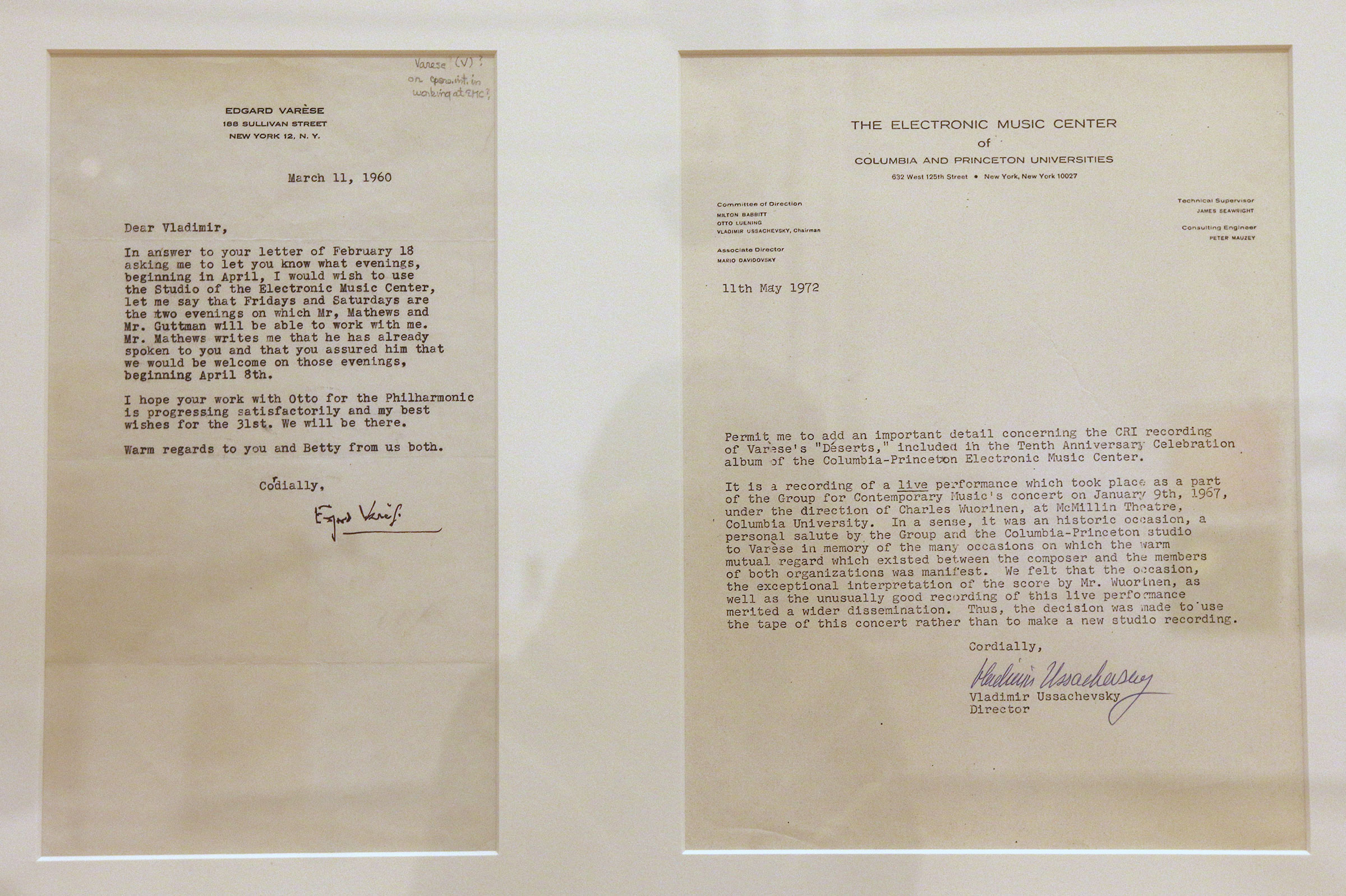
“While more and more blacks are being driven into homelessness,” a classical music fan fumed, “Mostly Mozart is rewarded with government, corporate, and media support.” The problem? No black composers on the program—not even Mozart’s great contemporary, Joseph Bologne, Chevalier de Saint-Georges.
We can easily imagine this critique as a sick Twitter burn from last summer, or last week. Calls to diversify classical music programs intensify regularly. But the sad truth is that many organizations are reluctant to pursue any path other than business as usual. (Others certainly aren’t.) Perhaps sadder still, the comment above dates from 1987. Mike Snell, a reader of Raoul Abdul’s music column in the New York-based Amsterdam News, wrote Abdul to eviscerate the media for not highlighting the systemic racism underpinning the lack of black representation on the concert stage.
Plus ça change.
Returning to the present: the music of one black composer, Florence B. Price, has experienced an extraordinary surge of public interest over the past year, mainly on the heels of extensive coverage of violinist Er-Gene Kahng’s world premiere recording of her two violin concertos in The New Yorker and The New York Times. Prominent U.S. orchestras, including the New Jersey Symphony, North Carolina Symphony, and Minnesota Orchestra, programmed Price’s music during their 2018–19 seasons. The Fort Smith Symphony Orchestra recently released the world premiere recording of her Fourth Symphony on Naxos Records. And more ensembles will likely take up the mantle, both in the United States and around the globe. The Chicago Symphony, for example, recently announced that it would perform Price’s Third Symphony in the 2019–20 season.
Given the longstanding historical exclusion of African American composers, Price’s sudden rise to stardom might raise a few eyebrows. Is the sudden widespread interest in Price’s music a convenient fad? Are predominantly white institutions exploiting her legacy for short-term gain—what Nancy Leong has called “racial capitalism”? These are the right questions to ask. Their skeptical slant is justified when a major trade publication can obliviously describe women composers as “in vogue.” And it would be far from the first time that white musicians bolstered their careers on the musical labor of black women, or that black women’s musical accomplishments have faced unfair scrutiny upon entering white public consciousness.
We can only speculate about how Price’s resurgent presence on the concert stage might bring about deeper structural changes over the long term. But, if we listen carefully, her unique experiences as a composer and as a black woman present us with a more immediate opportunity to name and fight racial injustice today. Mike Snell’s complaints—and those of concerned musicians before and after him—show that time has refracted these injustices to the present.
Plus ça change, indeed.
Open Our Ears
The persistence of anti-black racism in classical music spaces stems largely from the white majority’s refusal to engage meaningfully with black voices—or even to listen. In a detailed critique of the new music communities in which he has participated, composer Anthony R. Green encourages us to “trust these voices. Be critical, but respectful. Engage in exchange. Be patient. When our work is blatantly ignored, disrespected, not studied, and not programmed, our voice is all we have.” White people, even those with anti-racist sympathies, often recoil at the suggestion that they have harmed people of color and shift the discussion to defend their motivations—a phenomenon multicultural education expert Robin DiAngelo calls “white fragility.” But the fact that Green’s observations are not new simply proves the point.
Green’s critiques revolve around the classical music industry’s propensity to pigeonhole black composers as “one-trick ponies.” This dehumanization, he argues, occurs when concert organizers think about music by black composers only during Black History Month or, in more recent years, for concerts with a social justice theme. “While this is not necessarily negative,” he adds, “the injustice arises when absolute music or music with non-social themes by black composers is overlooked.” Florence Price’s daughter, Florence Robinson, expressed similar frustrations after Price died in 1953. Artists were happy to perform Price’s arrangements of Negro spirituals, but she found no advocates for her mother’s symphonic compositions.
Once a black composer finds an advocate, however, another problem is that concert organizers do not always think through the implications of poor framing. Price’s Symphony in E Minor, which Frederick Stock and the Chicago Symphony Orchestra famously premiered in June 1933, appeared on a program ostensibly devoted to celebrating black musical achievement.
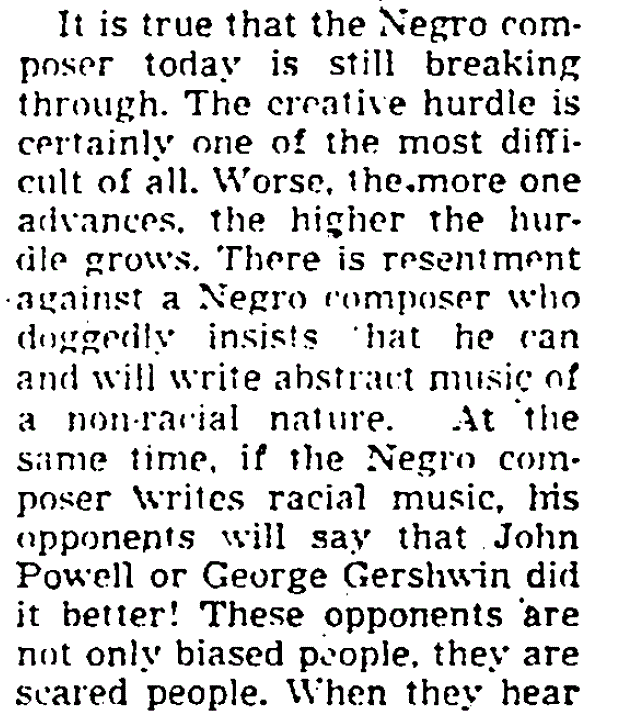
It featured tenor Roland Hayes and pianist Margaret Bonds as soloists in addition to pieces by Price and Afro-British composer Samuel Coleridge-Taylor. But the opening number was an overture by John Powell, an avowed anti-black eugenicist. Powell’s presence was an acute indignity for Price and the other black performers, especially since Chicago’s black newspaper, the Defender, had publicly criticized Powell earlier that year.
-

- John Powell, “Music and the Nation” (1923)
-

- Oscar E. Saffold, “How American Folk Songs Started,” Chicago Defender, 25 Feb. 1933
To make matters worse, the event occurred the night after a concert celebrating American music, which had not only neglected to include any black musicians, but highlighted George Gershwin’s symphonic jazz compositions—pieces epitomizing white appropriation and presumed “elevation” of a fundamentally black style. Were African American musicians not American? The juxtaposition is startling.
Critical comparisons between the two shows were inevitable. One critic wrote about both as a unit. “Gershwin,” she observed, “looks like his music,” while John Alden Carpenter (whose Concertino had appeared on the second program with Margaret Bonds as soloist) “took up the white man’s burden” for the evening. Price, in contrast, “was given to little communicative inspiration.” By what standard we’ll never know. And black musicians of the era were painfully aware of these racist gaffes and slights, as William Grant Still, a composer who had grown up with Price in Arkansas, demonstrated in scathing commentary published in the Pittsburgh Courier in 1950.

“Fifty Years of Progress in Music,” Pittsburgh Courier, 11 Nov. 1950
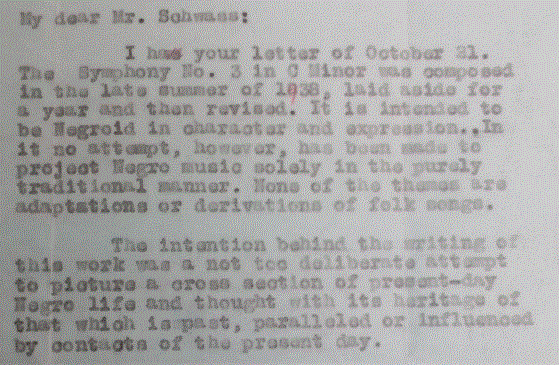
But what choice do black composers have in the matter given the racist status quo? Is saying no to a major opportunity a viable option, especially if it puts food on the table? In September 1940, a conductor in Detroit approached Price about setting up a performance of her orchestral music. He was “quite anxious to do something from your pen,” he told her, and asked for information about her orchestrations of black folk dances. Sensing the urgency of the situation, she sent him her abstract Third Symphony instead, along with a letter that has since become one her best-known artistic manifestos. Making sure he knew the character of the piece was unlike what he had requested, she added, “The other two movements—the first and the last—were meant to follow conventional lines of form and development.” The conductor had no choice but to program the piece, given few ready alternatives. But Price took a significant professional risk by not conceding to his original demands.

Price to Frederick Schwass, Florence Price Papers, Special Collections Division, University of Arkansas Mullins Library
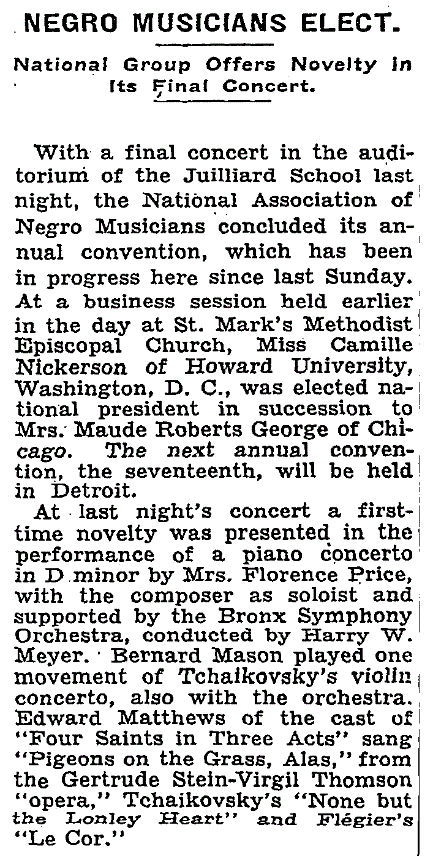
As these episodes show, ignorant, racist framing of black music prevents black composers from fully expressing their artistic visions and hampers listeners from approaching a piece on its own terms. Unilateral concert planning carries the risk of reifying racist norms. Creating a just environment means working with composers to find a frame that shows their music at its best. And here we can take a cue from history as well—from a 1935 performance of Price’s Piano Concerto given by the Bronx Symphony Orchestra in which the evening’s featured black musicians had taken an integral role in planning.

New York Times, 30 Aug. 1935
#BlackLivesMatter and Classical Music
Following Trayvon Martin’s brutal murder in 2012, Alicia Garza, Patrisse Cullors, and Opal Tomeli inaugurated the Black Lives Matter movement to publicize the precariousness of life itself for black Americans in a violently racist society—and, of course, to rectify the injustices underpinning it.[1] The halls of classical music may seem far removed from these issues, but only because they have remained predominantly white spaces. Indeed, as historian Kira Thurman has shown, classical music (even whistling it) could not protect Draylen Mason, a young bassist from Austin, Texas, from the bomber who targeted African American homes and ultimately killed him. White people must confront this stark reality, despite the luxury of being able to avoid it.
In her reflections on Mason’s death, Kira Thurman has explained that “we don’t know how to talk about” black classical musicians because “to be black and a classical musician is to be considered a contradiction.” This insight suggests that conventional writing about classical music and musicians tends to emphasize white (male) lineage and benevolence, usually at the expense of people of color. Stating one’s position in a prominent network, for example, is meant to be a signal that talent and grit, rather than race, gender, or status, led to success. Doing the work of justice will therefore entail developing a language that breaks reliance on white patriarchal norms and captures the nuance of an individual’s full humanity.
The experience of blackness cannot be reduced to violence, but I emphasize violence here since it has experienced its own series of refractions over the past several centuries—from family separation and horrific physical abuse under slavery, to lynching under Jim Crow and decades of unchecked police brutality. The pall of violence is so pervasive that many African American parents pass strategies for navigating it to their children in a family ritual known as “the talk.” And, as black feminist theorists such as Patricia Hill Collins and bell hooks have argued, black women are uniquely vulnerable.
Price was no exception, since violence had dramatically shaped both of her parents’ lives. A group of Irish bullies, for example, nearly assaulted Price’s father when he was a young man living in New York City simply for “wearing a tall silk hat” on the sidewalk. In a draft of his memoirs, Price annotated this moment as “the lynching.” Price’s mother, meanwhile, was abducted and nearly raped as a teenager in Indianapolis. Both were squarely middle-class, indicating that a relatively high socioeconomic status could not mitigate their victimization.
-

- Price memoir about father, Special Collections Division, University of Arkansas Libraries
-

- “Attempted Seduction,” Indianapolis News, 12 Aug. 1975
Conventional biographical writing about classical musicians leaves virtually no room for examining race-based experiences like these that might shape a musical career. The official biography of Price featured on the website of her current publisher, G. Schirmer, emphasizes her relationships to white institutions and teachers but elides the circumstances that brought her into contact with these individuals in the first place.
Price studied at the New England Conservatory, for example, but not because it welcomed her as an African American. Instead, her mother insisted that she take advantage of her racially ambiguous skin color to pass as a woman from Mexico and avoid unnecessary scrutiny of her African ancestry. This decision was not only a safety measure, but as historian Allyson Hobbs has shown, carried the potential to destroy families separated by the artificial color line. Likewise, though Price continued to study with prominent teachers in Chicago, as the biography states, she went to Chicago to flee from racist violence in Arkansas that culminated in an especially grisly lynching.

Description of a lynching
Further, musicologist Rae Linda Brown has shown that domestic violence caused Price’s marriage to fall apart shortly after the move, leaving her to raise her two young daughters with the assistance of a community of black women on the city’s South Side that included dear friend Estelle Bonds and her daughter, Margaret Bonds. That Price thrived in these environments says far more about her and the racist and misogynist circumstances she faced than the prestige that might have accrued from any institutional affiliations.
Justice, then, includes allowing a musician’s true self to be fully present when facing the public—to appear “at our best,” as Kira Thurman has called it. She explains that black classical musicians “embody the Brechtian concept of Verfremdung, making the familiar strange and uncanny. Our performances and our musical experiences challenge the bounds of blackness and whiteness and the histories of racial oppression that have tried to culturally and musically determine both.” Like Anthony Green, she insists that denunciations of racial profiling and critiquing structural inequality don’t have to come at the expense of aesthetic enjoyment—that violence and beauty are equally powerful. Papering over one or the other merely reifies centuries of structural inequality by sweeping it under the rug.
A Renaissance
Historical erasure is perhaps the most acute consequence of the institutional oppression and misunderstanding that Green and Thurman highlight. And here Price’s story offers another cautionary tale.
In 2009, a pair of renovators, Darrell and Vicki Gatwood, found a substantial cache of Price’s manuscripts —roughly thirty large archival boxes—at Price’s abandoned summer home near St. Anne, Illinois. These materials eventually moved to the Special Collections division at the University of Arkansas Mullins Library. This discovery and acquisition marked a true watershed for Price scholarship and advocacy, which had grown slowly but steadily with the limited materials Price’s daughter had already sent the university shortly before her death in 1975.
Price’s daughter, in fact, had struggled to find performances and publication outlets after her mother died in 1953. Some people tried to help but couldn’t, and she was occasionally suspicious of opportunists seeking to capitalize unfairly on her mother’s dwindling legacy. Things took a turn for the worse in 1974 when she became too ill to manage her mother’s affairs any longer. Barbara Garvey Jackson, a musicologist at the University of Arkansas, had been in touch her and finally convinced her to send a few manuscript scores to the university, including the famous symphony premiered by Frederick Stock and the Chicago Symphony Orchestra in 1933.
With these slivers in hand, Jackson planted the seeds for a Florence Price revival by publishing a major biographical article in The Black Perspective in Music. Rae Linda Brown, a graduate student at Yale who had stumbled upon a manuscript of Price’s Third Symphony in an archival collection, soon joined her and became a new leading voice in the revival as she published numerous articles on Price’s life and music.
Over time, Jackson and Brown worked with several distinguished musicians and scholars, including Helen Walker-Hill, Mildred Denby Green, Althea Waites, Linda Holzer, Calvert Johnson, Trevor Weston, Karen Walwyn, and the Women’s Philharmonic to bring Price’s music to the public. This work culminated in Brown’s editions of Price’s Piano Sonata and First and Third Symphonies (co-edited with Wayne Shirley for the series Music of the United States of America published by A-R Editions), Jackson’s series of publications for ClarNan Editions, Weston’s reconstruction Price’s Piano Concerto, and several ensuing recordings. This extensive labor extends beyond the fact that Price’s vocal music has been a staple on vocal recitals, especially those given by African American performers, since the 1930s. Richard Heard collected many of these songs in his edition called 44 Art Songs and Spirituals.
After the St. Anne discovery, several new individuals became involved in this ongoing Price revival, most notably Arkansas-based composer James Greeson. He used materials from the new collection to form the basis for a 2015 documentary, The Caged Bird, which has screened at venues across the United States and has become a staple of educational initiatives around the country.
While researching black composers of the early 20th century, I visited the University of Arkansas in May 2016 to peruse the original Price archival collection but ended up using the entire new collection since it had opened to the public the previous year. A report on my work was broadcast over WUOL 90.5 in Louisville, Kentucky, a few weeks later. I collaborated with the station again in the summer of 2017 to host an all-Price concert at the city’s annual Muhammad Ali Festival, which featured members of the Louisville Orchestra giving a contemporary premiere of one of Price’s “lost” string quartets. The quartet segment was later rebroadcast nationally on the syndicated show “Performance Today.”
Meanwhile, other performing groups such as the Apollo Chamber Players, The Dream Unfinished, the Boston Symphony Orchestra, the Orchestra of St. Luke’s, and the BBC Orchestra explored new areas of Price’s life and work.
Together, this collective but dispersed grassroots effort drew substantial new attention to Price’s life and music, which crested in the New Yorker and New York Times pieces mentioned earlier.
A White Savior?
If efforts to reinscribe Florence Price into the historical record were reaching new heights by the middle of 2018, what might the reification of structural inequality look like?
Publisher G. Schirmer announced last November that it had acquired worldwide rights to Price’s compositional catalog. In other words, the firm would serve as a clearinghouse for the publication, distribution, and licensing of Price’s scores. Previously, interested scholars or performers would have to visit the University of Arkansas to take photographs of the archival material (or pay the library for photographic reproductions) before engraving the music or performing from the manuscripts themselves.
Explaining the rationale behind the firm’s decision, promotional director Rachel Sokolow stated, “As more orchestras and presenters recognize the need to address diversity in classical music programming, we hope that Price’s oeuvre can be a valuable resource.” Citing the interest in Price that seemed to bloom after the extensive media coverage, G. Schirmer president Robert Thompson explained that it’s “important to insure that past composers like Julius Eastman and Florence Price are not forgotten, and that their legacies are living ones, celebrated through live performances and new recordings.”
On the surface, this may sound like a great idea with an ethical underpinning. Black composers like Price have obviously gone underserved for far too long. And the G. Schirmer website is far more convenient to access than a dusty archive. But, as musicologist Matthew Morrison’s work suggests, the firm risks joining the long line of predominantly white for-profit corporations hoping to circumscribe an equally white marketplace for black musical production if it overlooks the vibrant work that expanded the audience for Price in the first place.
At a glance, G. Schirmer’s official statements may seem reminiscent of what writer Teju Cole has called the “White-Savior Industrial Complex,” in which “the world is nothing but a problem to be solved by enthusiasm.” Perhaps many organizations rushing to program Price’s music are riding an enthusiastic wave rather than redressing injustice. But Cole’s formulation also illustrates the sharp differences between how an organization perceives itself and what the historical record shows. “All [the White Savior] sees is need,” Cole writes, and “he sees no need to reason out the need for the need.” In Price’s case, performing organizations neglected her music, but even G. Schirmer itself owns a small share of the responsibility for narrowing the marketplace and creating the lack of diverse programming we face today.
To wit: Marian Anderson premiered Price’s Songs to the Dark Virgin in November 1939 at a Carnegie Hall recital, with a repeat in January. A representative from Theodore Presser jumped on the opportunity, but Price had so much leverage that she ended up going with G. Schirmer over an offer from the equally prominent Presser. In other words, G. Schirmer knew about Price and her music but offered to publish only a tiny fraction during her lifetime.

Cover of Songs to the Dark Virgin, G. Schirmer, 1941
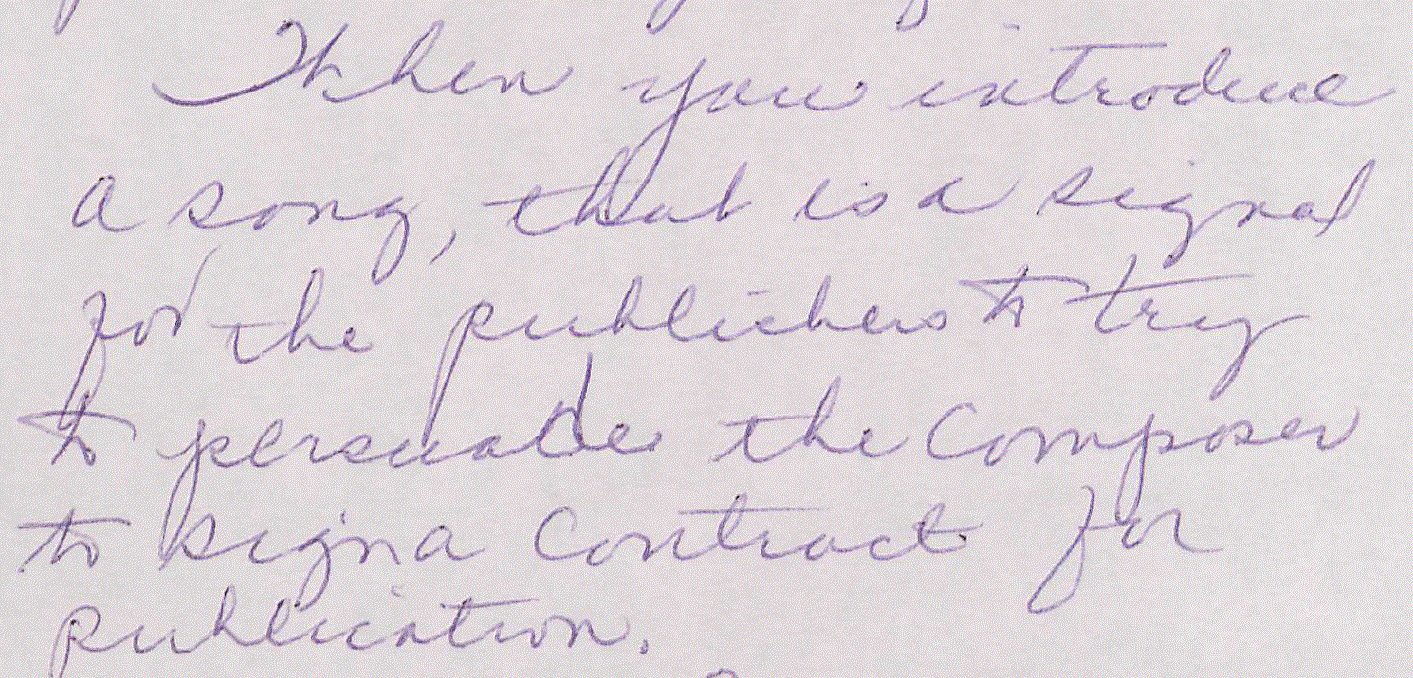
“When you [Anderson] introduce a song,” Price’s daughter once explained, “that is a signal for the publishers to try to persuade the composer to sign a contract for publication.” Price and Anderson worked together to capitalize on this knowledge of the system’s inner workings because Price occasionally had trouble finding publishers on her own. Ethnomusicologist Alisha Lola Jones has argued that this synergistic collaboration was a channel through which “black women empowered themselves to sound the (un)quieted, undisputed dignity of womanhood on the world’s stage” without the involvement of white benefactors.

Florence Robinson to Marian Anderson, Dec. 1966, Marian Anderson Papers, University of Pennsylvania
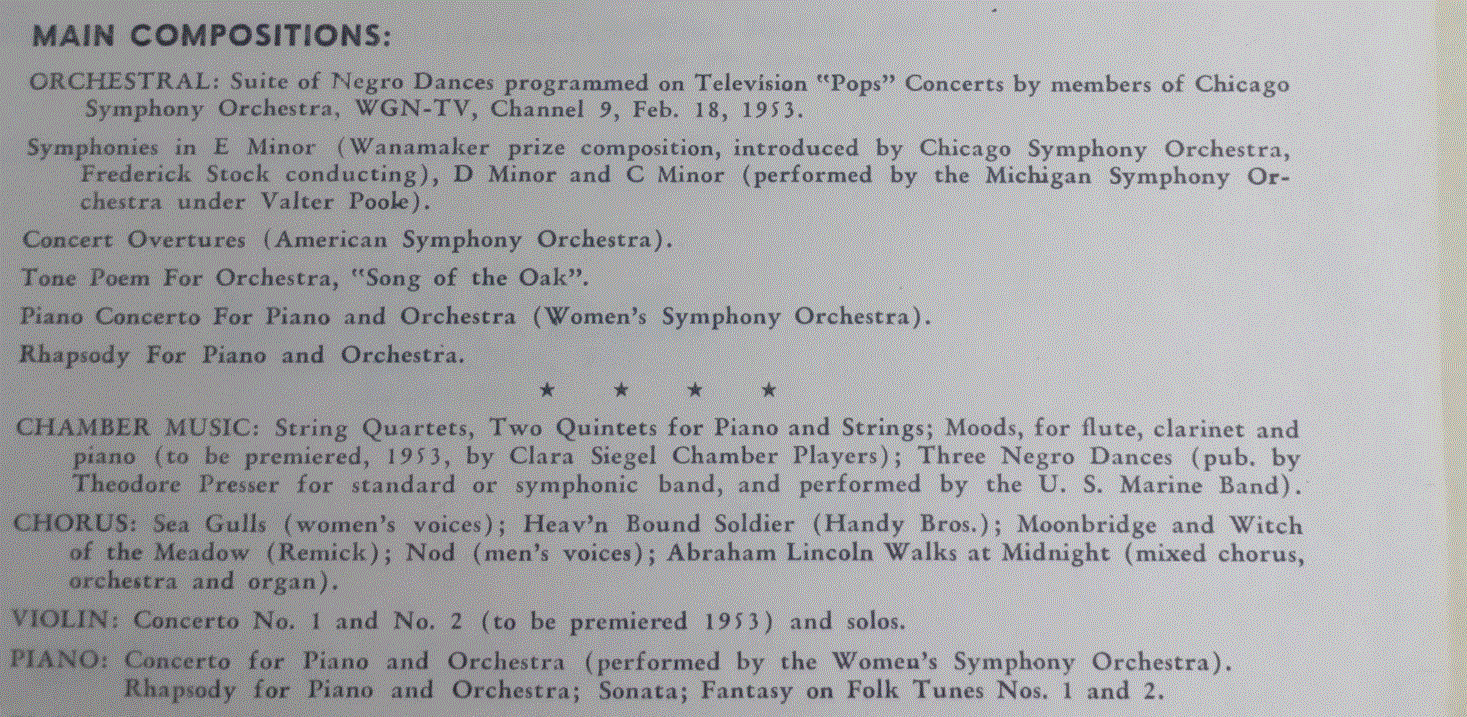
But Price could not rely solely on a community of women to bring her orchestral music before the public, and therefore to have any hope of publishing it.[2] This institutional neglect of her music during her lifetime explains why so many manuscripts were awaiting “discovery” after her death in the first place. Promotional brochures dating from Price’s lifetime show that her prolific catalog was public knowledge throughout the industry. ASCAP, of which Price was the first African American woman member, produced these brochures and distributed them widely.

Florence Price’s ASCAP Brochure
Why did no one offer to work with Price or her daughter to secure a legacy—the kind of legacy that G. Schirmer is now rightly pursuing? Publishers? Conductors? Instrumentalists? Even in the supposedly vaunted world of classical music, profit-seeking considerations and their deep ties to systemic discrimination often trump ethical concerns. In the heady environment of an exciting renaissance, white organizations run the risk of refusing to acknowledge black voices, especially those of black women, virtually ensuring that these voices become unsung to their posterity.
Within the complex matrix of composers, publishers, venues, performers, audiences, and critics, we must all play a role in creating a just musical community. Or we will keep repeating the same patterns of oppression.
A Classical Postscript
As it turns out, Joseph Bologne’s music also has an esteemed but spotty publication history dating from his own lifetime in the late 18th century. Famous houses like Antoine Bailleux and Jean-Georges Sieber published him alongside J.C. Bach, Luigi Boccherini, and others. After a long publication hiatus, one of the foremost scholars of black music, Dominique-René de Lerma, worked with Peer International to publish a series of Bologne’s chamber music in 1978—a full decade before music fan Mike Snell wagged his finger at New York’s Mostly Mozart Festival.
Plus ça change.
Thank you to Dr. Alisha Lola Jones and Samantha Ege for providing substantive feedback and additional sources for this essay.
1. BLM should not be confused with the Movement for Black Lives, which is a separate but occasionally overlapping organization.
2. University of York musicology Ph.D. student Samantha Ege is arguing in her dissertation that Price’s social circle did in fact offer material support for the Chicago Symphony concert once her piece became a viable option for Frederick Stock.